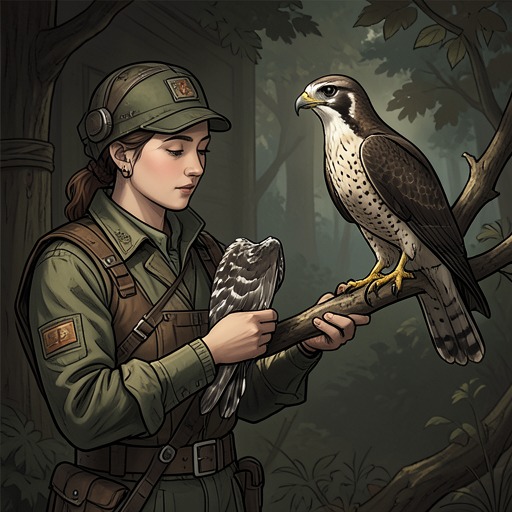
Mabel's rabbit hunt
H is for HawkMabel's rabbit hunt is the moment when falconry becomes more than a way for Helen to move through grief: the uncertainty of the hunt itself takes hold as a powerful new attraction. In a wood at the edge of a field, Mabel vanishes after her quarry, leaving Helen to follow the sounds of the chase rather than control its outcome. When the goshawk returns, the hunt has changed Helen's sense of time, attention, and her own participation in the natural world.
Background and Approach
The hunt takes place after a longer process of learning to read Mabel. Helen has become intensely attentive to the goshawk's posture and feathers, treating small changes in them as signs of her mood. That close observation is not a guarantee of control: it teaches Helen to anticipate Mabel while also making her more closely bound to what the hawk notices and does. Earlier, Mabel's playful responses to paper toys had unsettled familiar expectations about goshawks. The hunt extends this changing relationship into a setting where the bird acts beyond Helen's immediate reach.
The social history of falconry gives the outing another dimension. Helen reflects that falcons had been celebrated as noble birds in part because flying them properly required extensive open land, often available to the wealthy or well connected. Goshawks, which can hunt after a short flight from the fist, did not depend on the same expanses. Their solitary trainers, or austringers, and the goshawks themselves were often disparaged in falconry writing. Yet Helen had also encountered earlier accounts describing goshawks as wary but sociable when treated with kindness. Against that background, hunting with Mabel is not simply a display of mastery over a supposedly difficult bird; it involves attending to an animal whose actions cannot be reduced to inherited descriptions or the falconer's intentions.
On this occasion Helen takes Mabel along a narrow lane to a nearby farm where she had once had permission to fly her hawks. She is unsure whether that permission still applies and proceeds without checking. Before entering the wood, she scans the fields and sees no tractors, farm workers, dog walkers, or other people. Keeping low, she and Mabel move around a blackthorn thicket. Three rabbits are feeding near the woodland edge, and a cock pheasant walks nearby. The scene is quiet and ordinary; Helen understands that releasing the hawk will abruptly introduce danger into it.
The Chase
Helen circles the wood, crouching and holding her breath, with her attention fixed on the birds and their relative positions. Mabel holds her wings away from her body and moves her head as she watches. At the final corner, Helen extends her gloved fist from behind the brush. Mabel launches from it with force. Helen steps out to watch as the action resolves in quick, distinct stages: the goshawk flying low, the rabbits running, and the pheasant also moving towards the shelter of the wood.
The chase does not unfold as a visible, continuous pursuit. Mabel turns sharply and disappears beneath a low larch branch at the wood's edge. The rabbits and pheasant are no longer in Helen's sight either. For a moment, the opening in the trees seems to contain the whole event, while Helen has no clear view of what the hawk is doing. The scene reverses the ordinary arrangement between observer and animal: Helen has released Mabel, but the decisive action now belongs to the bird, beyond the reach of her gaze.
Helen enters the wood and stands still to listen. At some distance to her left, she hears movement, breaking sticks, and the sound of Mabel's bells. She thinks the noise may mean the hawk has caught a rabbit, but cannot yet know. Following the sound, she moves through the undergrowth and reaches a large warren. Mabel runs out of a tangle of thornbushes and flies up to Helen's fist. Chalk from the rabbits' burrows covers the hawk's toes and marks Helen's glove as Mabel eats. The return makes the hunt legible through its consequences: the catch itself had been hidden, but Mabel has come back with her quarry and resumed contact with her falconer.
A Shift in Attention and Time
Helen recalls that the hunt felt unlike her previous experience of hunting with a hawk. For its duration, the surrounding world seemed to fall away even as its details became intensely present. After less than an hour, she returned to the road surprised by how far the sun had fallen; subjectively, the outing had seemed to last much longer. The change in time is tied to the structure of the hunt. Helen must watch for the chance of action, then accept that Mabel's flight and the result cannot be directed once the hawk leaves her fist.
The outing also marks a change in Helen's understanding of why she hunts. Grief had initially driven her to fly Mabel, but Helen says that by this point her grief was gone. She is not describing a simple recovery or a return to ordinary life. Instead, the hunt occupies the space left behind: in the wood, her attention narrows to the hawk and the possible movements of the quarry, and the rest of the world temporarily recedes. The physical distance between Helen and Mabel during the chase makes that absorption possible while also exposing its limits. Helen can prepare, observe, and follow; she cannot ensure the outcome.
Consequences and Significance
Helen rejects the idea that falconry is merely an especially intense form of birdwatching. She compares it instead to gambling: the falconer invests skill and feeling in a process, then relinquishes control when the hawk flies. Practice can make success seem possible, but it cannot remove chance. The period between release and outcome is therefore central to the experience. Helen describes it as a place of vulnerability and exhilaration, where the world's uncertainty becomes something she is willing to seek out.
That recognition gives the hunt its lasting consequence. Helen identifies the outing with Mabel as the beginning of an addiction: not because the scene simply demonstrates a successful capture, but because it reveals how compelling the surrender of control has become. The hunt brings her into close relation with another animal's action, yet it also offers a way to lose herself in uncertainty. Mabel remains an active hunter rather than a guaranteed instrument of Helen's purpose; the hidden chase and unexpected return make that distinction visible. The episode thus joins attentive partnership to risk, and shows how a practice first entered through bereavement can become a new means of escape.